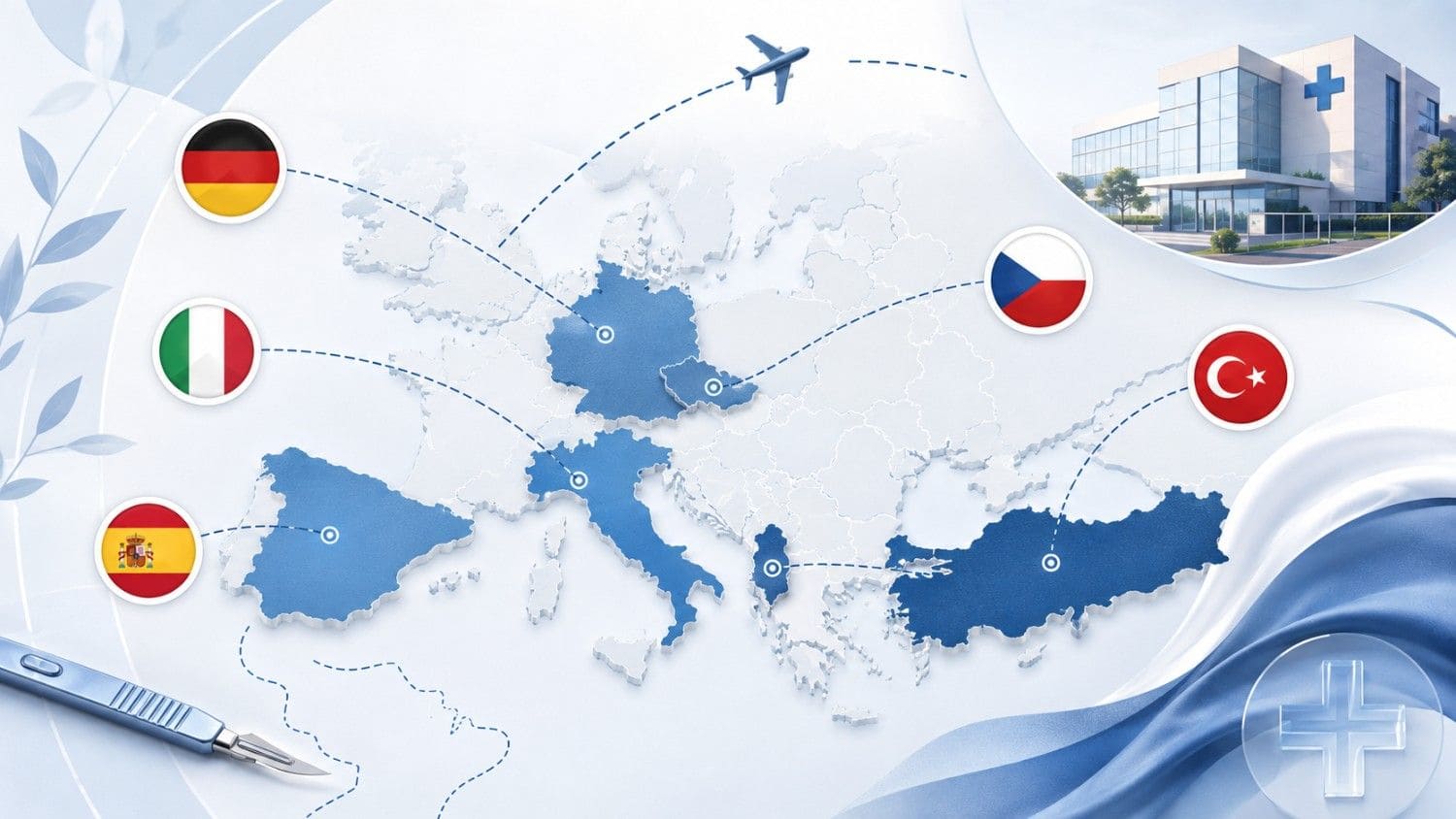
The number of people travelling abroad for plastic surgery has grown substantially over the past decade. Lower costs, shorter waiting times, and access to experienced surgeons in internationally accredited facilities have made medical tourism a legitimate and well-trodden path for patients across Europe and beyond.
But the industry is not without risk. For every reputable hospital offering world-class care, there are clinics operating with inadequate infrastructure, underqualified staff, and no meaningful oversight. The consequences of choosing the wrong provider — infection, botched results, complications without access to emergency care — can be severe and lasting.
This guide is designed to help you make that choice well. It is a practical, honest checklist built around the questions every patient should ask before committing to plastic surgery abroad — regardless of which country or clinic they are considering.

Why the Stakes Are Higher Abroad
Having surgery in your home country carries inherent protections you may not even be aware of: regulatory oversight of surgical facilities, professional licensing bodies that can investigate complaints, and the ability to follow up with your surgeon easily if something goes wrong.
When you travel abroad, some of those protections need to be actively sought rather than assumed. The distance between you and your provider matters. Language barriers can affect informed consent. Post-operative follow-up is harder to coordinate. And if a complication arises after you return home, your local healthcare system will need to manage it — often without full knowledge of what was done or how.
None of this means surgery abroad is inherently unsafe. It means the due diligence required is higher, and the questions you ask before you travel are more consequential than they might be at home.
The Checklist: What to Verify Before You Book
1. Is the Hospital or Clinic Properly Accredited?
This is the single most important question on the list.
Accreditation is not the same as a certificate on a website. Legitimate international accreditation involves rigorous on-site inspections by independent bodies assessing surgical safety, infection control, staff qualifications, emergency protocols, patient rights, and quality of care across the entire patient pathway.
Look for internationally recognised accreditation bodies. In the context of medical tourism specifically, TEMOS (Treatment Abroad Medical Organisation Standards) is one of the most credible — it is designed specifically to evaluate hospitals and clinics for the care of international patients, assessing everything from pre-operative communication to post-operative follow-up and emergency preparedness.
What to do: Ask for the provider’s accreditation certificates. Verify them independently on the accrediting body’s official website. If a clinic claims accreditation but cannot produce a certificate or a verifiable listing, treat that as a serious red flag.
2. Is the Facility a Proper Hospital or a Clinic?
There is a meaningful difference between a full-service hospital and a standalone clinic — and it matters most when something goes wrong.
A full-service hospital has on-site intensive care, emergency medicine, anaesthesiology, diagnostic imaging, blood banking, and specialist support across multiple disciplines. If you experience a complication — a reaction to anaesthesia, unexpected bleeding, a cardiac event — the resources to manage it are immediately available within the same building.
A standalone clinic or day surgery centre does not have these resources. In the event of a serious complication, you will need to be transferred to a hospital. In a country where you do not speak the language, at night, in a post-operative state, that transfer is a significant additional risk.
What to do: Confirm whether the facility is a licensed hospital or a clinic. Ask specifically what happens in the event of a serious post-operative complication — which hospital would you be transferred to, how far away is it, and what is the protocol?
3. What Are the Surgeon’s Qualifications and Experience?
A surgeon’s skill is the most direct determinant of your outcome. Verifying that skill requires asking specific questions — and being wary of vague or evasive answers.
Key questions include:
- Where did the surgeon train, and in which countries are they licensed to practice?
- Are they a specialist in plastic and reconstructive surgery, or a general surgeon performing cosmetic procedures?
- How many procedures of the specific type you are considering do they perform per year?
- Are before-and-after photos of their own patients available for the procedure you are considering?
What to do: Request the surgeon’s CV or professional biography. Look for board certification or membership in recognised surgical associations — in Europe, the European Board of Plastic, Reconstructive and Aesthetic Surgery (EBOPRAS) is a meaningful credential. Ask to see a portfolio of results specifically for your procedure. A surgeon who is reluctant to share this information is telling you something important.

4. Is the Consultation Thorough and Honest?
The quality of your pre-operative consultation is one of the clearest signals of the quality of care you will receive throughout.
A thorough consultation should include a physical assessment of your anatomy, an honest discussion of what is and is not achievable for your specific body, a clear explanation of the procedure and its risks, and realistic before-and-after expectations — including the possibility that surgery may not be the right choice for you at this stage.
Be cautious of consultations that feel like sales meetings. If a surgeon agrees immediately with everything you say, promises you exactly the result you describe without examining you, or discourages you from asking questions, those are warning signs. Experienced surgeons push back when appropriate. They tell patients what they cannot achieve as clearly as what they can.
What to do: Prepare a list of questions in advance. Pay attention to whether the surgeon listens, examines, and explains — or simply quotes and books. If the consultation is conducted exclusively online without a physical assessment, understand that the pre-operative planning is necessarily incomplete.
5. What Are the Anaesthesia Arrangements?
Anaesthesia complications account for a significant proportion of serious surgical adverse events. The qualifications of the anaesthesiologist and the monitoring equipment available during your procedure are not peripheral details — they are central to your safety.
What to do: Ask who will administer your anaesthesia. Confirm they are a trained specialist anaesthesiologist — not a nurse or technician operating independently. Ask what monitoring equipment is used during surgery and what the protocol is for anaesthetic emergencies.
6. What Does Post-Operative Care Look Like?
For medical tourists, post-operative care is where the pathway most often breaks down. You may be discharged from the facility and expected to manage recovery in a hotel room before flying home — sometimes within days of surgery.
This is not inherently dangerous if managed correctly. But it requires clear protocols: who do you contact if you have concerns? Is there a nurse available to assess you? What are the criteria for needing to return to the hospital? When is it safe to fly?
What to do: Ask for a written post-operative protocol before you travel. Confirm the follow-up arrangements — will you be seen by the surgical team before discharge? Is there a point of contact available for questions after you return home? Will your surgeon communicate with your GP or local doctor if needed?

7. What Is Included in the Price — and What Is Not?
Price transparency is a basic standard that reputable providers meet without hesitation. A quote that looks attractively low may not include anaesthesia fees, hospital overnight stays, compression garments, post-operative medications, or follow-up appointments. Understanding exactly what you are paying for prevents unpleasant surprises and allows meaningful comparison between providers.
What to do: Request an itemised quote in writing. Ask specifically what happens — and who pays — if a complication requires additional treatment or an extended stay.
8. Can You Find Independent Patient Reviews?
Marketing materials are produced by the provider. Patient reviews — particularly those published on independent platforms rather than the clinic’s own website — reflect the actual experience of real patients and are considerably more informative.
What to do: Search for the provider on independent review platforms. Look for patterns across multiple reviews rather than individual outliers. Be appropriately sceptical of providers with only five-star reviews and no critical feedback of any kind — this can indicate curated or managed testimonials.
Red Flags: When to Walk Away
Some signals should prompt you to reconsider a provider entirely, regardless of cost or convenience:
- Inability to produce verifiable accreditation certificates
- Pressure to book quickly or deposit urgently
- Before-and-after photos that appear to be sourced from elsewhere, or results that look implausibly uniform
- A surgeon who cannot be identified by name, credential, or verifiable professional profile
- No clear protocol for emergencies or post-operative complications
- Resistance to answering specific clinical questions
- Consultations conducted entirely by coordinators or patient managers, with no direct access to the operating surgeon before booking

What a Good Provider Looks Like
To make the checklist concrete, here is what responsible, high-quality plastic surgery abroad actually looks like in practice.
The facility holds verifiable international accreditation — ideally from a body like TEMOS that specifically evaluates international patient care. The hospital is a full-service medical facility with on-site emergency support, not a converted building or standalone clinic. The surgeon is a trained specialist with a transparent professional profile and a portfolio of results. The consultation is thorough, honest, and conducted by the surgeon themselves. The pre-operative and post-operative protocols are written, detailed, and shared with you before you commit. The price is itemised and complete.
This is the standard that Hygeia Hospital Tirana holds itself to. We are Albania’s only TEMOS-certified hospital for international patient care. Our plastic surgeons are trained to international standards and communicate directly with patients — in English and other languages — throughout the process. Our facility was designed and built from the ground up as a hospital, with access to full emergency infrastructure, advanced diagnostics, and specialist support across disciplines.
We share this checklist not to sell you on Hygeia, but because we believe informed patients make better decisions — and better decisions lead to better outcomes, regardless of where you choose to have your surgery.
Final Thoughts
Plastic surgery abroad can be an excellent choice. But it requires more active due diligence than surgery at home. The questions in this checklist are not difficult to ask — and any provider worth choosing will answer them clearly and without hesitation.
If a clinic cannot meet this standard, the low price is not worth it. The cost of a complication — financially, physically, and emotionally — is always higher than the cost of choosing well in the first place.
If you would like to arrange a consultation at Hygeia Hospital, or simply have questions about our accreditation, surgical team, or care protocols, contact us here.
Written by the Plastic Surgery Department at Hygeia Hospital Tirana — Albania’s only TEMOS-certified hospital for international patient care.